 |
 |
| Main | The Equinox: Race & Course |
Physics
for Runners 101 |
Rooty Trails |
Killer Hills |
Downhill Dash |
Flat to the Finish |
How to Run the Equinox |
Sources & Further Reading |

|
If the
final 4-mile-long section of the Equinox were run in
isolation, it would be a cinch. That it is run in
conjunction with the 22 preceding miles of complex
terrain makes it anything but. By this point in the
race, many runners have "bonked," or hit their
physiological threshold due to severely depleted
glycogen and/or electrolyte levels. Except for the
most rugged and masochistic athletes, this physical
exhaustion is usually coupled with a mental bonk.
Your body and brain are done slogging. "Enough is
enough!" they shout at you in unison. So while the
sight of flat pavement would ordinarily elicit
delight, few Equinox runners find much comfort in
it.
|
| More
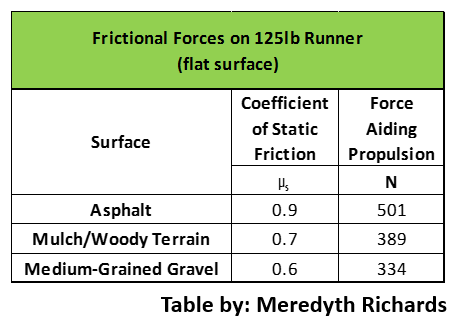
About Projectile Motion The first of two physics principles that can help runners tackle the flat pavement requires revisiting the parabolic motion explored in the overview of the Rooty Trails section of the course. Recall this graphic: 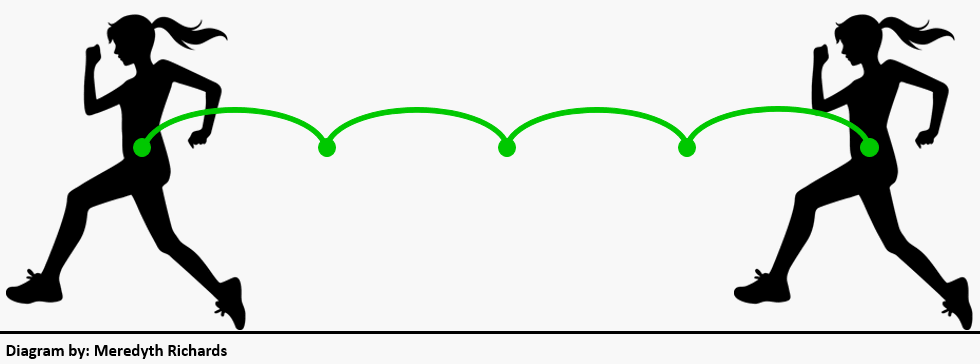 When the surface is even, with every footfall the runner's center of gravity returns to the same vertical position relative to the ground. This is a constant. How far forward the runner's center of gravity travels, however, can change because this lateral distance is affected by both the direction and magnitude of the applied force (assuming no wind and invariable friction). If the runner is able to maintain a consistent speed through a consistent applied force, the lateral range of her stride is affected only by the direction of her applied force. To see why, compare the runner's trajectory to that of a projectile, with the "range" as the length of each stride. 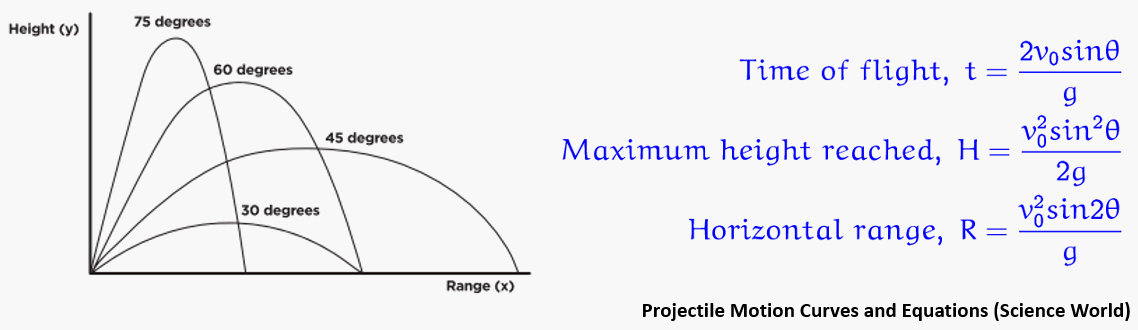 As noted previously, 45 degrees is the angle at which the greatest range for a given launching force is achieved assuming no air resistance. Typical values for stride length and runner pace can be incorporated into the projectile motion equations used to establish the projectile curves. Doing so numerically validates the above results as well as offers theoretical projections of Equinox finish times for different running styles. 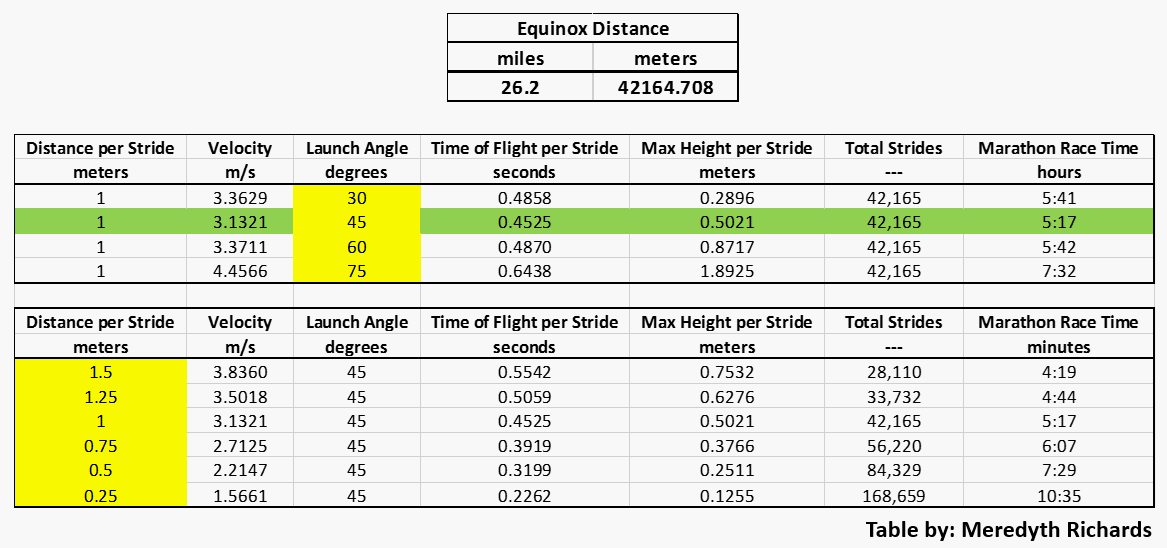 A typical recreational runner on a flat surface can reasonably maintain a stride length of approximately 1 meter, which equates to a bit over 42,000 strides to complete the race. By varying the launch angles for this consistent stride range, it is possible to back-solve, first for velocity and then for time of flight and maximum vertical height per stride. As suspected, 45 degrees leads to the fastest race time, nearly a half-hour faster than 30 degrees and 60 degrees. According to the physics, a leap forward that temporarily lifts the runner's center of mass by a half-meter is optimal.* Knowing that the 45 degree launch angle is preferable, will shortening or lengthening each stride improve race results? The physics is unequivocal: yes. Longer strides lead to faster times. Looking at the data, this seems backwards. Longer strides are associated with more time away from the ground and a greater distance above the ground per stride. This means the runner has far fewer opportunities to apply a propulsive force throughout the course of the marathon. However, the runner also needs far fewer total opportunities to launch in order to reach the finish line. This advantage more than compensates for the increased time in the air, producing significantly faster times.** *As a long-distance runner, sustaining this seems ambitious if not entirely infeasible. **Important to note is that the energy expenditure demanded by long strides is significant. The physics explained above is why sprinters take very long, energy-intensive strides; long strides are undoubtedly the most expedient way to move around a track when energy conservation is not a concern. Distance runners, however, use much shorter strides as energy management is essential to success. Though certainly not as long as a sprinter's stride, elite marathoners have mastered the physics of projectiles with their remarkably long strides. Tangentially, man's shorter strides can help explain his ability to run long-strided prey to exhaustion during persistence hunts. The Friction Factor In order to launch forward as a projectile off of any surface, ideally at 45 degrees, a runner pushes backwards on the ground. This force (aimed to the right) applied by the foot generates an opposing frictional force (aimed to the left) by the Earth that pushes the runner in the desired direction (Knight, 197). For a flat surface, the magnitude of the "boost" is a function of the mass of the runner and the coefficient of friction. Consequently, for the same runner, a larger coefficient of friction offers more help forward. As shown below, during the last section of the Equinox, our runner gets an extra "μsmg" boost from friction.  Typical estimates of
between
rubber shoes and clean, dry* asphalt, mulch/woody terrain, and medium-grained
gravel are
0.9, 0.7, and 0.6, respectively. Therefore, of all the possible surfaces,
a 125lb Equinox runner benefits the most from friction
during the final stage of
the race:
 It certainly does not feel like anything is helping move you towards the end, especially during the unending final flat section, but physics shows that some forces are actually lessening the load. Compounded over 26.2 miles, the frictional boost can certainly add up to real energy savings. Mindful of this, runners should actively seek debris-free pavement along the route to allow the most direct contact between their shoe and the asphalt. Those who know anything about Fairbanks in late-September will immediately protest any generalizations about ground surfaces. More often than not, the Equinox's frictional forces will deviate from the theoretical expectations. Fairbanks' habit of snowing and/or dropping well below freezing mere days before/during the race clearly complicates any frictional analysis. Patches of ice-coated wood are common along the first 9 miles as is icy gravel on Ester Dome. Fresh ice slicks on the pavement are not uncommon either. Coefficients of friction in these situations can plummet to 0.1 or worse, offering no assistance to haggard runners whatsoever. And finally, variations in runner footwear, specifically tread material and design, also complicate how much or little friction is present. A nuanced study of the medley of frictional forces experienced during the Equinox is well outside the scope of this study. Luckily, Kanstad et. al and Li et. al have picked up this slack and written extensively about friction and running here. *As if this is ever the case during the Equinox. |