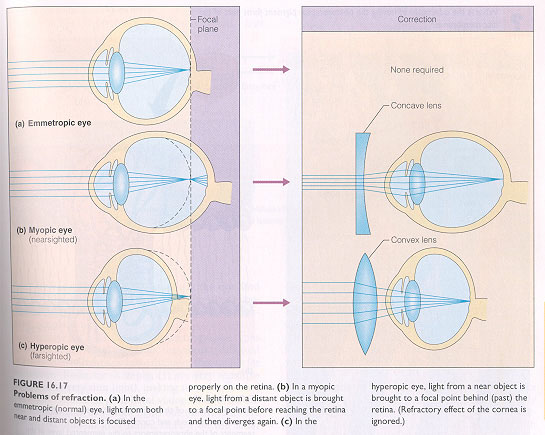
Homeostatic Imbalance of Refraction
Visual problems related to refraction can occur due to overconvergence or underconvergence of the lens from structural abnormalities of the eyeball. Two of the most common problems are myopia and hyperopia.
Myopia
Myopia occurs when distant objects are focused in front of the retina. People with this problem can see close objects clearly but distant objects appear blurred. Hence these people are sometimes called nearsighted. This condition typically results from a longer that normal eyeball. To correct the problem usually a diverging lens, which diverges the light before it enters the eyeball, is placed in front of the eye. However, recent advances in technology have allowed us to cure the problem with laser surgery, which flatten the cornea slightly. This puts the light bent by the cornea in focusing range of the lens.
Hyperopia
Hyperopia occurs when essentially parallel light rays from a far off object focuses behind the retina. These individuals see distant objects perfectly because the ciliary muscles contract constantly to increase the light-bending power of the lens, which moves the focal point forward onto the retina. However, diverging light rays from nearby objects are focused so far behind the retina that the lens can't bring the focal point onto the retina. To correct the problem a converging lens is placed in front of the eye to bend the light more strongly close vision.