Sound and the Mechanism of Hearing
General Structure of the Inner Ear
Transmission of Sound to the Inner Ear
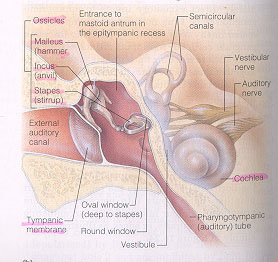
Airborne sound enters the external auditory canal, strikes the tympanic membrane and sets it vibrating at the same frequency (remember waves traveling between medium don't change frequency). The displacement of the membrane varies with the intensity. The motion of the tympanic membrane is amplified and transferred by the bone structure collectively called the ossicles to the oval window (see figure to right). The ossicle lever system acts much like a hydraulic press to transfer the same total force hitting the eardrum to the oval window, thus increasing the pressure delivered to the oval window by twenty fold.
Note: in pic below the cochlea is "rolled out" for ease of explanation
 Resonance
of Basilar Membrane
Resonance
of Basilar Membrane
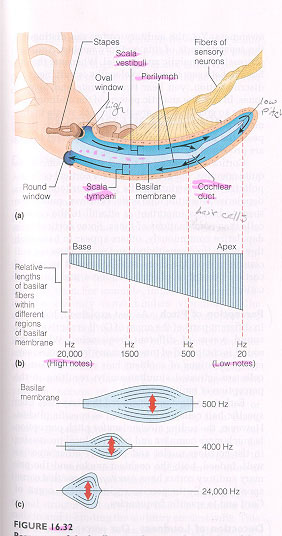
The motion of the ossicles rocks the oval window back and forth,
which in turn rocks the fluid inside the cochlea, called perilymph,
back and forth. This causes the basilar membrane to move up and
down, as air currents might cause water to move up and down on
a beach causing water waves. The up and down motion of the basilar
membrane causes the nearby part of the cochlear duct to oscillate
in time (see figure to left). Sound of frequency lower than 20
Hz doesn't oscillate the cochlear duct enough, and it goes through
the oval window, throught the scala vestibuli and scala tympani,
and out the round window. Such sounds are below the threshold
of hearing. Sounds of higher frequency do oscillate the cochlear
duct enough, but instead of going all the way through the cochlea
they take a "shortcut." The oscillation of the cochlear
duct in the scala vestibuli causes simultaneous oscillation in
the scala tympani, so the tip of the cochlea is bypassed. The
oscillation of the perilymph in the scala tympani is transmitted
to the round window and out.
As one moves along the basilar membrane one finds that different
segments of the membrane are set to resonate at a set frequency.
This causes a maximal displacement in different part of the membrane
for a particular frequency. This allows for distinction of different
frequencies.
 Excitation
of Hair Cells
Excitation
of Hair Cells
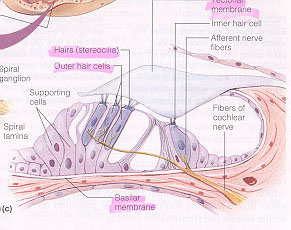
As the basilar membrane oscillates the imbedded hair cells, whose cilia at the tips are imbedded in the stationary tectorial membrane, are "tweaked." This generates an action potential in the hair cells, which relays the information to the brain.