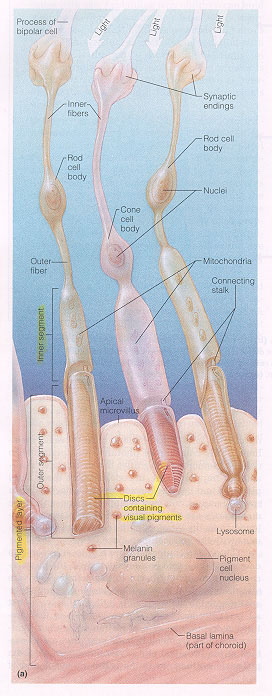
 Once
light passes the lens it travels the length of the eyeball and
encounters two types of cells at the back of the eye, which change
the electromagnetic energy of the photons to chemical energy which
ultimately allows the brain to give a form to the image. These
cell types are known as rods and cones. Rods and cones contain
unique visual pigments, which absorb different wavelengths in
the visible region of the electromagnetic spectrum. They also
have different thresholds for activation. Rods are very sensitive
and respond to very dim light, thus they are best suited for night
vision and peripheral vision. They absorb all wavelengths of visible
light, but their inputs are perceived only in gray tones. On the
contrary, cones need bright light for activation so they have
low sensitivity. However, they have pigments that give the world
its color.
Once
light passes the lens it travels the length of the eyeball and
encounters two types of cells at the back of the eye, which change
the electromagnetic energy of the photons to chemical energy which
ultimately allows the brain to give a form to the image. These
cell types are known as rods and cones. Rods and cones contain
unique visual pigments, which absorb different wavelengths in
the visible region of the electromagnetic spectrum. They also
have different thresholds for activation. Rods are very sensitive
and respond to very dim light, thus they are best suited for night
vision and peripheral vision. They absorb all wavelengths of visible
light, but their inputs are perceived only in gray tones. On the
contrary, cones need bright light for activation so they have
low sensitivity. However, they have pigments that give the world
its color.In addition rods and cones are connected differently to other retinal neurons causing further differences in their abilities.
Because cones are involved in distinction of color they play a role in color blindness. If a person is missing a particular type of cone cell (due to genetic or other reasons) they will not be able to distinguish that particular color. However, colorblind people can get around that problem because they learn to rely on other cues, such as differences in intensities of the same color, to distinguish something green from something red, such as a traffic light.