The Eye and Vision
Vision is our dominant sense: it is estimated that 70% of the sensory receptors are in the eyes and nearly half the brain is in one way or another involved in processing visual information. In humans the complex structure that allows our brain to receive visual information is the eye. Complex as it may be, however, the eye is governed by basic laws of classical physical and the process of vision can be understood through their study.
General Overview- refraction and lenses
Our everyday experience tells us that light travels in straight lines. When light encounters a surface it does three things. Some of the light is reflected off the surface, some is absorbed by the surface and heats the surface in the process, and the rest is transmitted through the surface. When light rays travel from one medium into another they are refracted according to snell's law:
where the n is the index of refraction of the medium and q is the angle, measured from the normal to the surface, the light is refracted.
A lens is a piece of transparent material curved on one or both surfaces. When an infinitely far away point-source light travels through a double convex (both sides curved so thickest part is in the center) lens it is refracted so that the light converges and is focused behind the lens at the focal point. The distance where the image is formed behind the lens in such a case is called the focal point. Generally the thicker the lens the more the light is bent and the shorter the focal point. Convex lenses are often used to form real images, which are upside down and reversed from right to left.
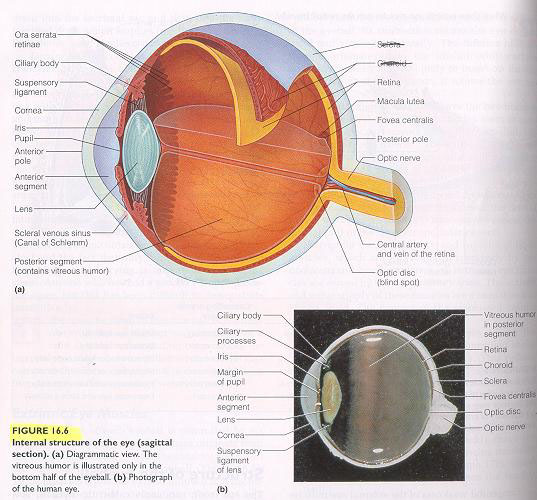
General Eye Structure
Fig. 1
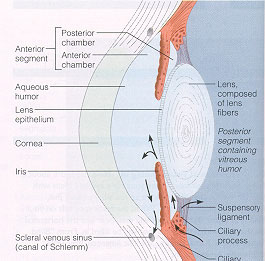 Fig. 2
Focusing of Light on the Retina
When light passes from air into the eye it is bent three times: as it enters the cornea, and on entering and leaving the lens. Although the cornea is responsible for the maximum light refraction in the eye, it thickness is constant so it can't regulate vision too much. The lens, however, is highly elastic and by changing its surface curvature it can change the focal point of the incoming light, thus allowing for fine focusing of the image.
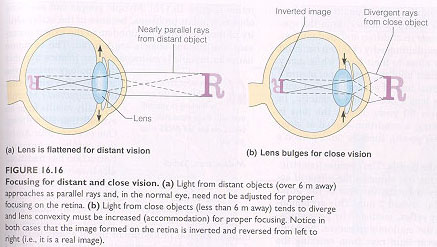 Focusing
for Distant Vision
Focusing
for Distant Vision
Our eyes are most adapted for distant vision. We only need to aim our eyeballs and fix them on a distant object and the image becomes automatically clear. In other words, the lens of the eye doesn't have to change its shape much.
Focusing for Close Vision
As the object comes closer our eye has to make active adjustments in order to make a sharp image. The following three processes are involved in accomplishing this.
A) Accommodation of the
Lenses
Accommodation
is the process that changes the refractory power of the lens so
that the diverging light rays are bent more sharply. To do this
the ciliary muscles in the eye contract and bring the ciliary
body forward (see Fig 2 above). This relieves some of the tension
in the suspensory ligaments and the lens becomes more spherical.
This more spherical lens has a more curved surface, hence a shorter
focal length, which focuses the light just right. The closest
point on which we can focus clearly is called the near point of
vision. This point corresponds to the maximum bulge the lens can
achieve, and all objects beyond this point are out of focus. The
near point of gets larger with age, which is why children can
read books close to their face, while old people have to hold
them at arm's length.
 B)
Constriction of the Pupils
B)
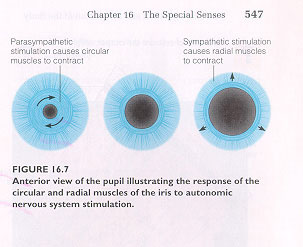
Constriction of the Pupils
The
circular muscles of the iris enhance the effect of accommodation
by reducing the size of the pupil. This is reflex controlled by
the parasympathetic (or the involuntary) part of the brain. Constriction
keeps the most diverging light from entering the eye and making
the image blurry due to lack of proper focus. This effectively
makes the eye act like a pinhole camera and increases the clarity
and depth of focus.
C) Convergence of the Eyeball
When
we fixate our eyes on a close object our eyes must converge and
point toward the object for best clarity. Therefore, the medial
rectus muscles rotate the eyeball so each is pointing toward the
object being viewed. When the object is too close, such as your
nose, you "go cross-eyed."