It is interesting to see the
bubble mimics the colors of a rainbow. On a
clear, sunny day or in a lighted room, the
bubbles will shine iridescently with the
colors of a rainbow. Also, sometimes the
colors are different on different sides of the
bubble.
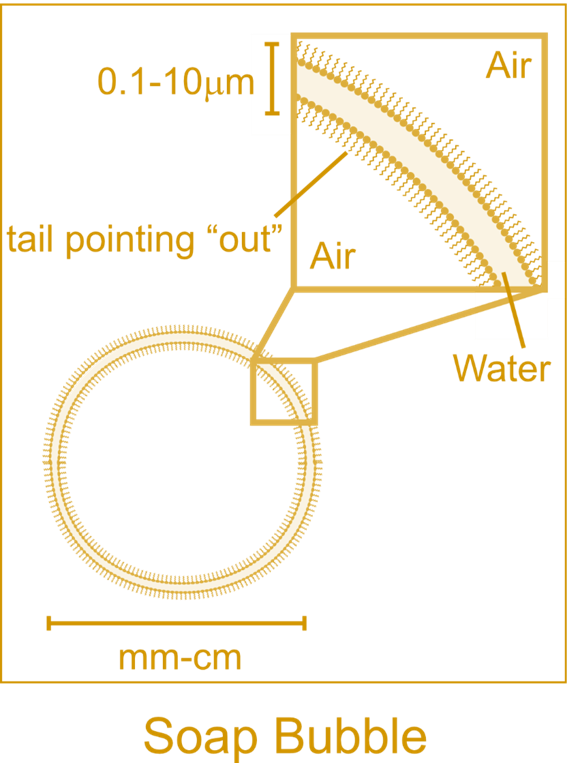
Figure 6. This image was shown on the
Soap & Water Interaction
page. It shows the
"trio of layers" of a bubble.
(http://www.clearbiology.com/)
The University of Wisconsin, Madison’s physics
department was able to conclude that bubbles
act similar to a prism, diffracting any light
that touches it into its individual colors,
the colors of a rainbow. This is because of
the “trio of layers,” a top and bottom layer
of soap molecules with water molecules in
between (Figure 6) (6). Scientist Jennifer
Hackett determined that these layers are
nanoscale thin, thinner than one-hundredth of
a human hair, the same size as different
visible light wavelengths. This allows the
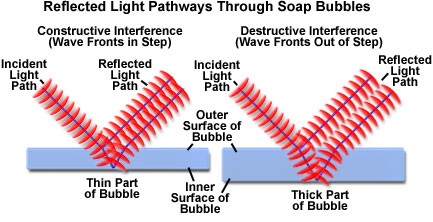
light beams to bounce off the top and bottom
of the bubble, slightly out of sync (Figure
7), causing the beams to cancel each other out
(also known as interference) (6). Because of
this, the bottom of the bubble had different
colors than the top. Gravity pulls the soap
and water molecules downward, causing the
bottom to be thicker, which shows more greens
and pinks. The thinner sides will show yellows
and blues. The thinnest part or the top, will
be almost completely clear, because it is so
thin that no visible light escapes (6).
Figure 7. Visual comparison of when
the light reflects of the
thin and thick parts of a bubble, causing
light interference.
(http://micro.magnet.fsu.edu/)