
Marie Curie's main field of study, radioactive decay or
radioactivity, is when an unstable molecule emits
radioactive particles in order to become more stable.
These radioactive particles include alpha, beta, and
gamma particles but scientists have more recently discovered
more kinds of particles that may be released through
radioactive decay. Each particle consists of different
materials from the parent molecule. Alpha particles are
composed of two protons and two neutrons and beta decay has
to do with electron and positron emmision. Gamma decay
occurs when alpha or beta particles are released in order to
release excess energy from the molecule.
When a molecule emits radioactive particles it becomes
more stable and in some cases results in an entirely
different element forming after the decay has occurred. In
some cases this new element created may then be radioactive
itself which can create a cascading set of radioactive
elements. Uranium is an element that does this sometimes, as
seen below, after each decay another radioactive element is
formed all the way to lead.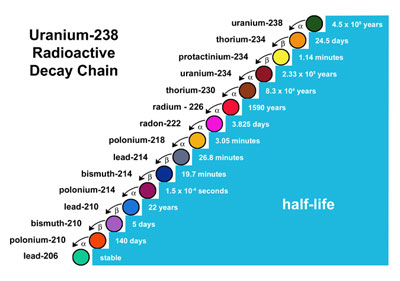
image from New Mexico Bureau of Geology and
Mineral Resources
| Each particle has different
effects on the parent molecule and different levels of
penetrating power seen in the image to the left. (picture
from Wikipedia) |
 |
As shown in the picture alpha particles have the lowest
amount of penetrating power and can be stopped by something
as thin as a sheet of paper while beta particles require
something such as a sheet of aluminum to stop them. Gamma
particles are the strongest of these three and requires
several inches of lead in order to be stopped.