
-

Applications of the RHR
If You haven't learned the basics yet, I'm glad to know you're excited to become a member of the Right Hand Crew, however, to be a member means understanding the principles of how we work. So before you get started check out our last blog post to get yourself caught up, link below.
Learning the Basics
-
At this point you have an idea of what a vector is and how to take the cross product of two vectors. But what is that good for? I'll tell you, here in the Right Hand Crew we go by one Rule that takes advantage of the cross product to help us understand how electromagnetic fields and charged particles / currents interact.
-
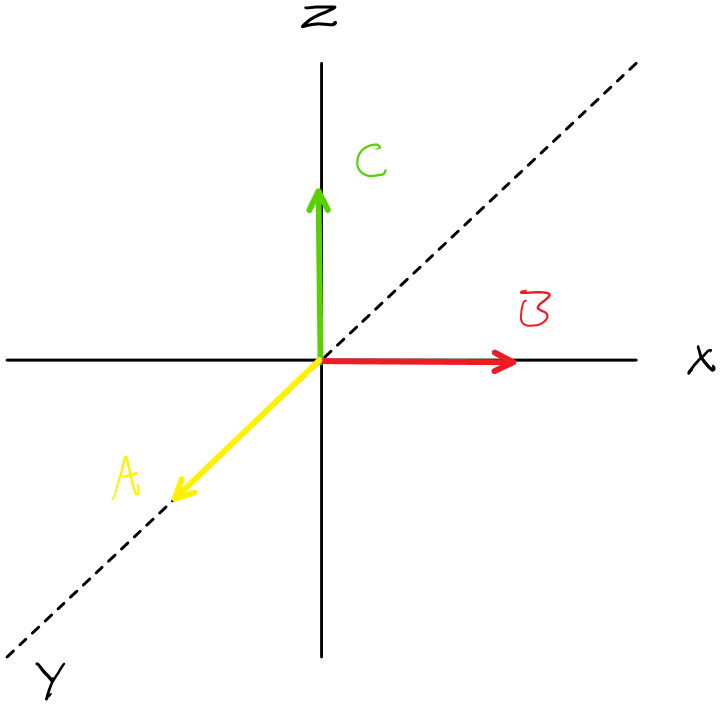
Say we have three vectors A, B, and C where A x B = C (where 'x' represents the cross product) The order of A and B matters, we can visualize this later with the right hand rule. To the left is a graphical view of A, B, and C: To use the Right Hand Rule make the first vector ( A ) your pointer finger and the second vector ( B ) your middle finger. If you hold your thumb out, align your pointer, and middle finger correctly then the resultant vector ( in this case C ) will be in the same direction as your thumb.
-
You may have heard of our rivals, the Left Hand Rule, put simply you use you're left hand when you want to find the direction of the negative cross product. In our above example ( A x B ), using the Left Hand Rule would give a resultant vector in the opposite direction of 'C'.
-
NOW LET"S GET PHYSICAL!!!
-
With some examples of applying the right hand rule:
-
Senario 1
-
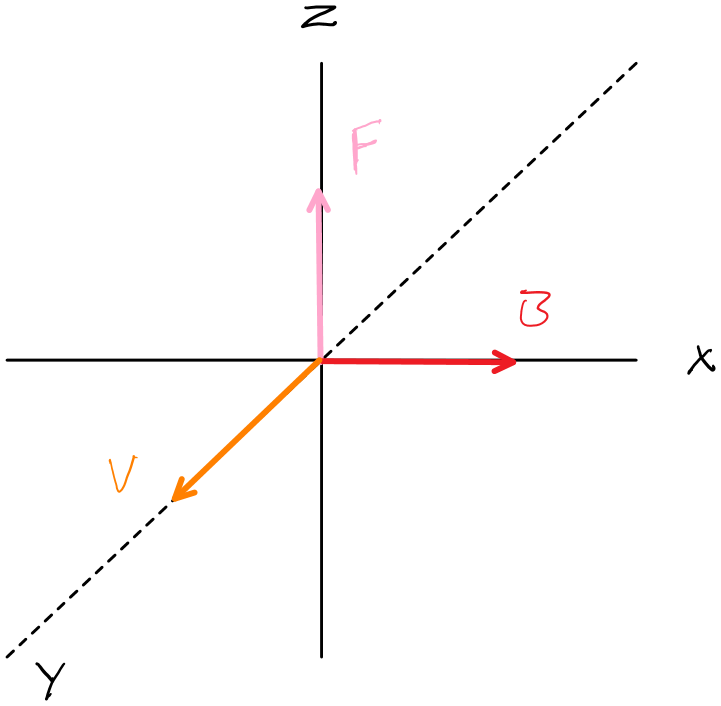
Say we have a positively charged particle traveling though a constant magnetic field. If we want to know the force on said charged particle created by the magnetic field we can use F = q v x B where F is the vector for force, q is a scalar for the charge, v is the velocity vector, and B is the magnetic field vector. To the Left is an example of how these vectors relate. As you can see if you point your first finger in the direction of the velocity and your middle in the direction of the field your thumb will point in the direction of the force on the particle.
-
What's great about the right hand rule is how simple it is. So long as you have two of the three puzzle pieces you can always find the third, just be sure to remember which digit each vector corresponds to.
-
Senario 3
-
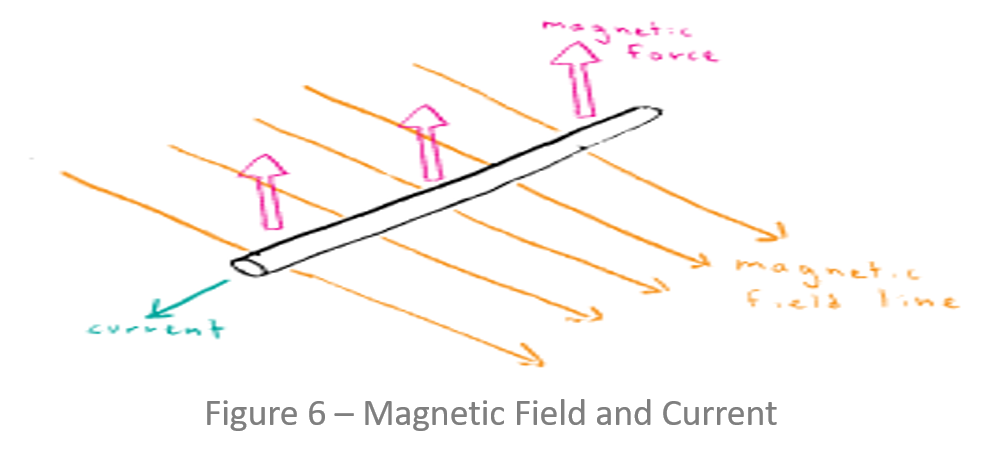
Now let's take things up a notch. If you think about it, current flowing through a wire is just a bunch of charged particles traveling in the direction of current. If said wire is Not parallel to a surrounding magnetic field then we can find the force exerted on that wire by the field. Point your pointer finger in the direction of the moving charged particles, aka direction of current, and your middle in the direction of the magnetic field. And Vuwala, by looking at the direction of your thumb you now know the direction of the force applied to the wire by the magnetic field!
-
Senario 3
-
Another application of right hand rule is finding the direction of the induced magnetic field from the direction of current in a wire. To do this, simply point your thumb in the direction of the current and wrap your hand around the wire (figuratively, don't try wrapping your hand around high current wires, that can be deadly). the direction your fingers curl around the wire determines the direction of the magnetic field.
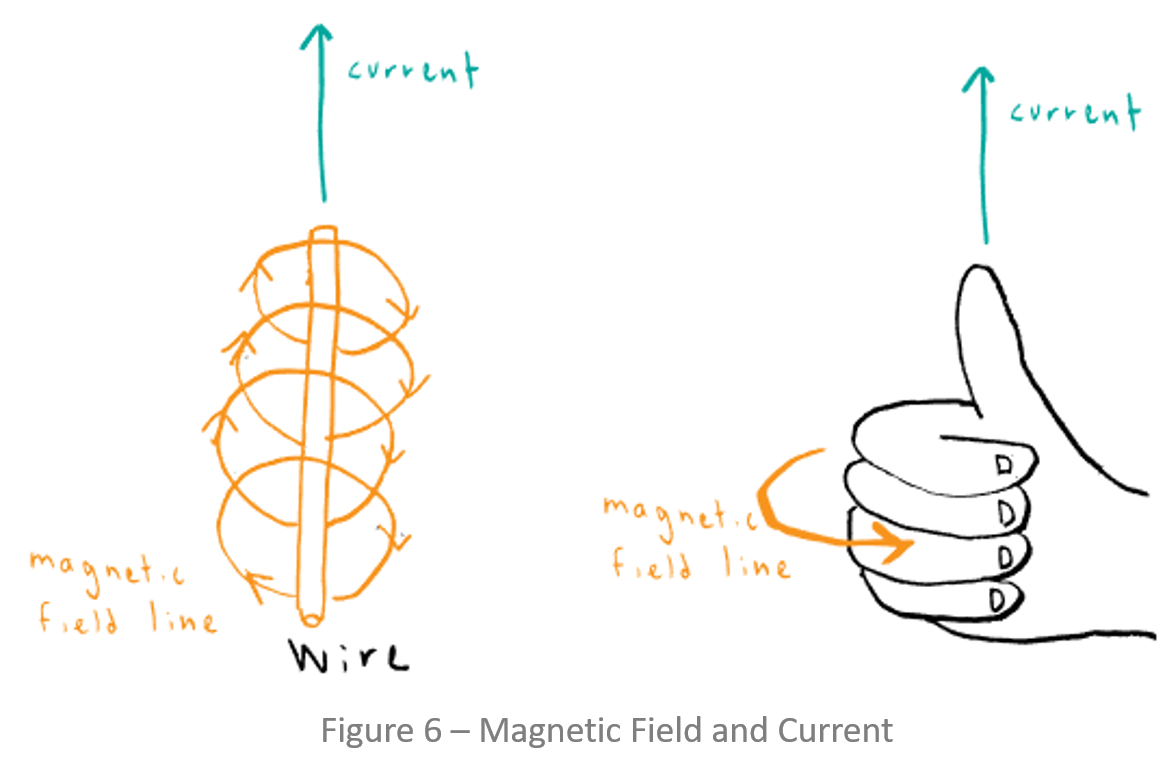
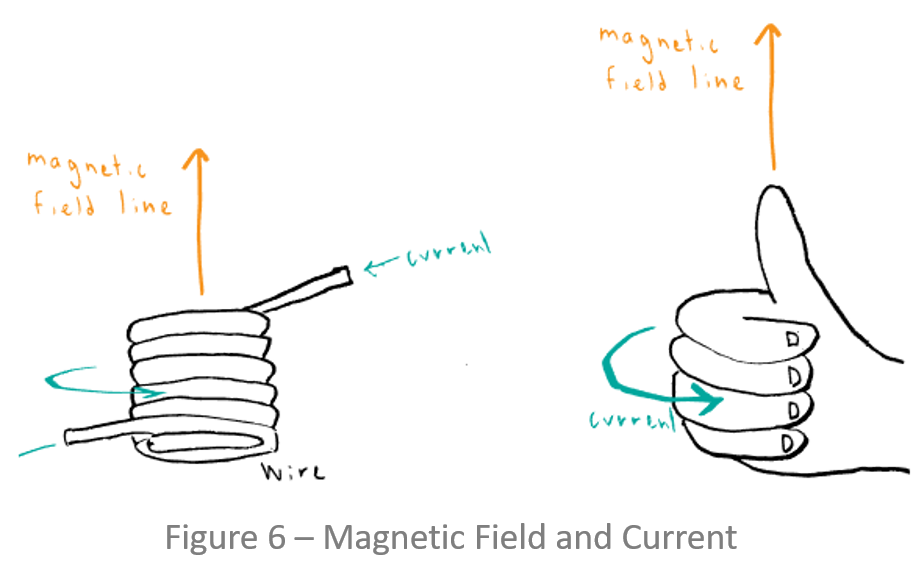
If we take this principle and extrapolate to a coil of wire we can get the direction of the magnetic field by 'wrapping' our hand around the coil in the direction of current. The corresponding direction of our thumb represents the direction of the magnetic field.
-
Last Note; many of our crew members like to use a special kind of notation for representing direction. The best way to remember this is to think of an arrow. If an arrow is fired into a wall you see the fletching (feathers on the back of the arrow), and if an arrow is fired from the other side of the wall you may see point of the arrowhead sticking through. Similarly, the direction of a vector can be represented by an X (like the fletching) to mean into the page, and a dot represents the vector coming out of the page.
-
Keeping all this in mind, you are now ready to test your skills. Move on brave and eager reader your initiation awaits.
-
Next Blog Post:

Initiation Quiz
Are you ready to test your new-found knowledge and skills in the applications of the Right-Hand Rule? To join this crew first, you must prove you’re self, but be wise as once you have proven yourself you will have a greater understanding of our world than ever before...
read more »