How do Earthquakes occur?
Earthquakes are primarily caused by the rupture of rocks in the earth's crust along faults. Most earthquakes typically take place along faults located in plate boundaries. As discussed previously, tectonic plates are always slowing moving, but sometimes they get stuck at their edges due to frictional forces. Eventually the forces and stresses caused by the movement of plates will build up and overcome the frictional forces felt along their edges. When this happens, an earthquake occurs and releases energy in the form of seismic waves.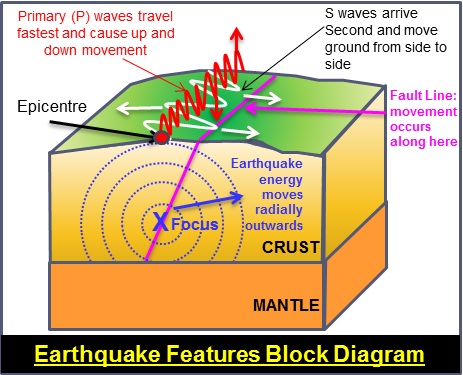
Fig 6. Gamesby,
Rob. "Background to Earthquakes." Coolgeography.co.uk.
N.p., n.d. Web. 11 Apr. 2015.
<http://www.coolgeography.co.uk/GCSE/AQA/Restless
%20Earth/Earthquakes/Earthquakes%20background.htm>.
Seismic Waves
A seismic wave is a type of elastic wave caused by an impulse such as an explosion or earthquake. Seismic waves generated during an earthquake can be broken down into body waves and surface waves.Body Waves
Body Waves travel from an earthquakes hypocenter through the
interior of the earth. Seismic body waves are divided into primary
waves (P waves) and secondary waves (S waves).
Fig 7. Body wave... (?) Thompson, Jeff. "Science of
"The Wave"" Jeff
Thompson.
N.p., 09 May 2011. Web. 11 Apr. 2015.
<http://www.jeffreythompson.org/blog/
2011/05/09/science-of-the-wave/>.
Primary Waves
(P Waves)
Velocity of P waves (α) in m/s
α = ((κ
+ 4/3μ) ρ)^1/2
κ
= bulk modulus of the rock (resistance to volume change)
μ = modulus of rigidity (resistance to change in shape)
Secondary
Waves (S Waves)
Velocity of S waves (β)
in m/s β = (μ/ρ)^1/2
μ
= modulus of rigidity (resistance to change in shape)
μ = 0 in liquids, thus velocity of S waves in liquids is zero
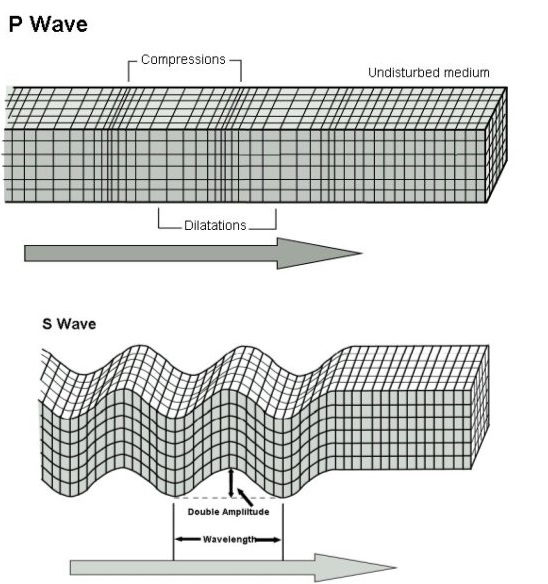
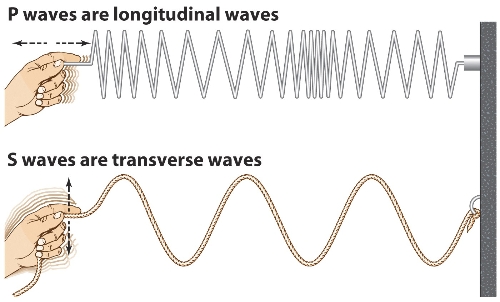
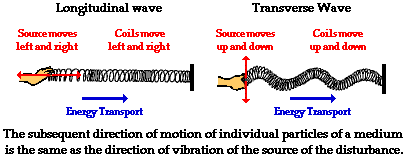
Fig 8. "219G
-
Faulting and Earthquakes." 219G -
Faulting and Earthquakes. N.p., n.d.
Web. 11 Apr. 2015.
Fig 9. "Properties of
Waves and Wave Cycles. Scalar, Transverse,
Energy and More.
<http://www.aeic.alaska.edu/input/west/guides/amato_faulting/ASRA_index.html>.
- The Light Coalition." The
Light Coalition. N.p., 20 Jan. 2015. Web. 11 Apr. 2015.
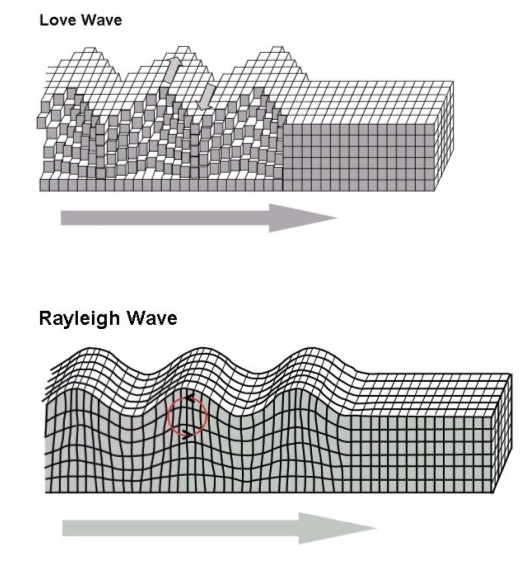
Surface waves
- Rayleigh and Love
Simply put, seismographs work by using
the knowledge of Newton's First Law (Law of Inertia) that states:
objects in motion will stay in motion, while objects at rest will
stay at rest.
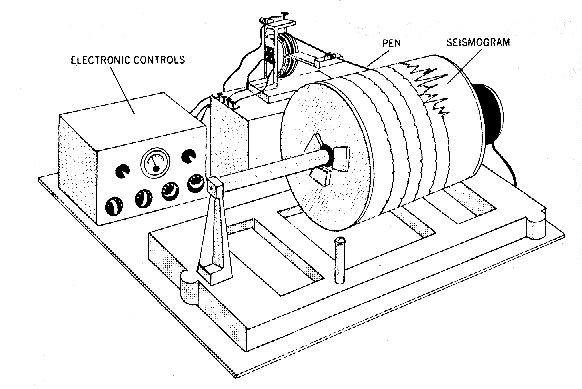
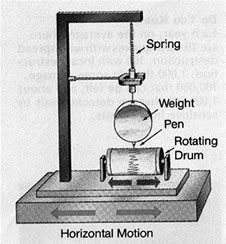
Fig 12. "Lab 10 - Earthquake Epicenter
Location." Lab 10
- Earthquake Epicenter Location. N.p., n.d.
Fig 13. "Why So Many
Earthquakes Recently? It's Physics." Science
2.0. N.p., 14 Apr. 2010. Web. 10 Apr. 2015
Web. 10 Apr. 2015.
<http://www.oakton.edu/user/4/billtong/eas100lab/lab10quake.htm>.
<http://www.science20.com/news_articles/why_so_many_earthquakes_recently_its_physics-66846>.
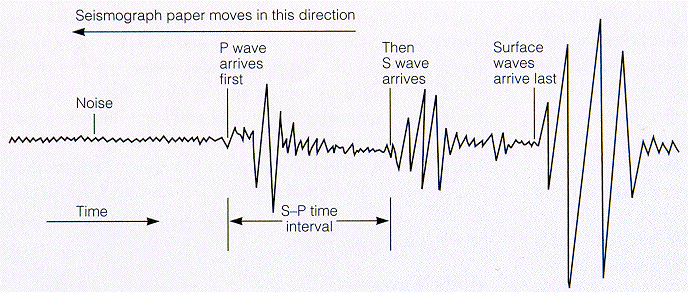
Fig 14. "Earthquakes,
Richter
Scale, and Logarithms." Continuous
Everywhere
but Differentiable Nowhere. N.p., 29 July 2008.
Web. 11 Apr. 2015.
<http://samjshah.com/2008/07/30/earthquakes-richter-scale-and-logarithms/>.
Using the Time-Distance Relationship between S and P waves to Locate the Epicenter of an Earthquake
V = dx/dt (vector – has direction) V = d/t (scalar – does not have direction)
The velocity difference between P and
S waves means that the time interval between the first P waves and
S waves increases with distance from the earthquake. (Remember, P
waves are faster than S waves) With this relationship, the time
interval between P and S wave arrivals measured at seismograph
stations is actually an indication of the distance that the
station is located from the epicenter. In order to locate the
epicenter of an earthquake, there must be at least three
seismograph stations, otherwise this specific method will not
work. The P and S wave time difference is used as the radius of a
circle around each station. When there are three stations, three
separate circles can be plot. Where these three circles intersect
is the location of the epicenter.
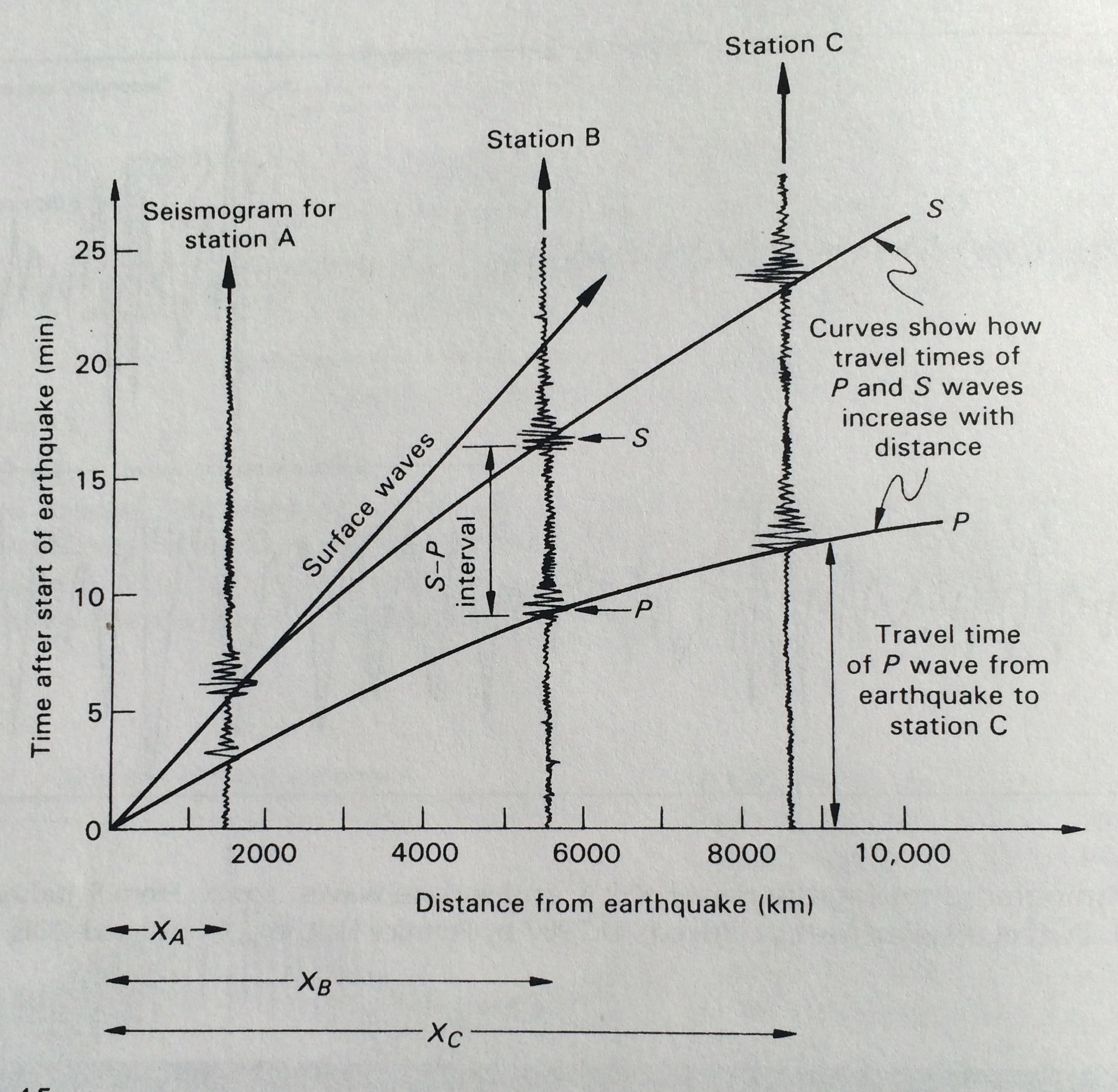
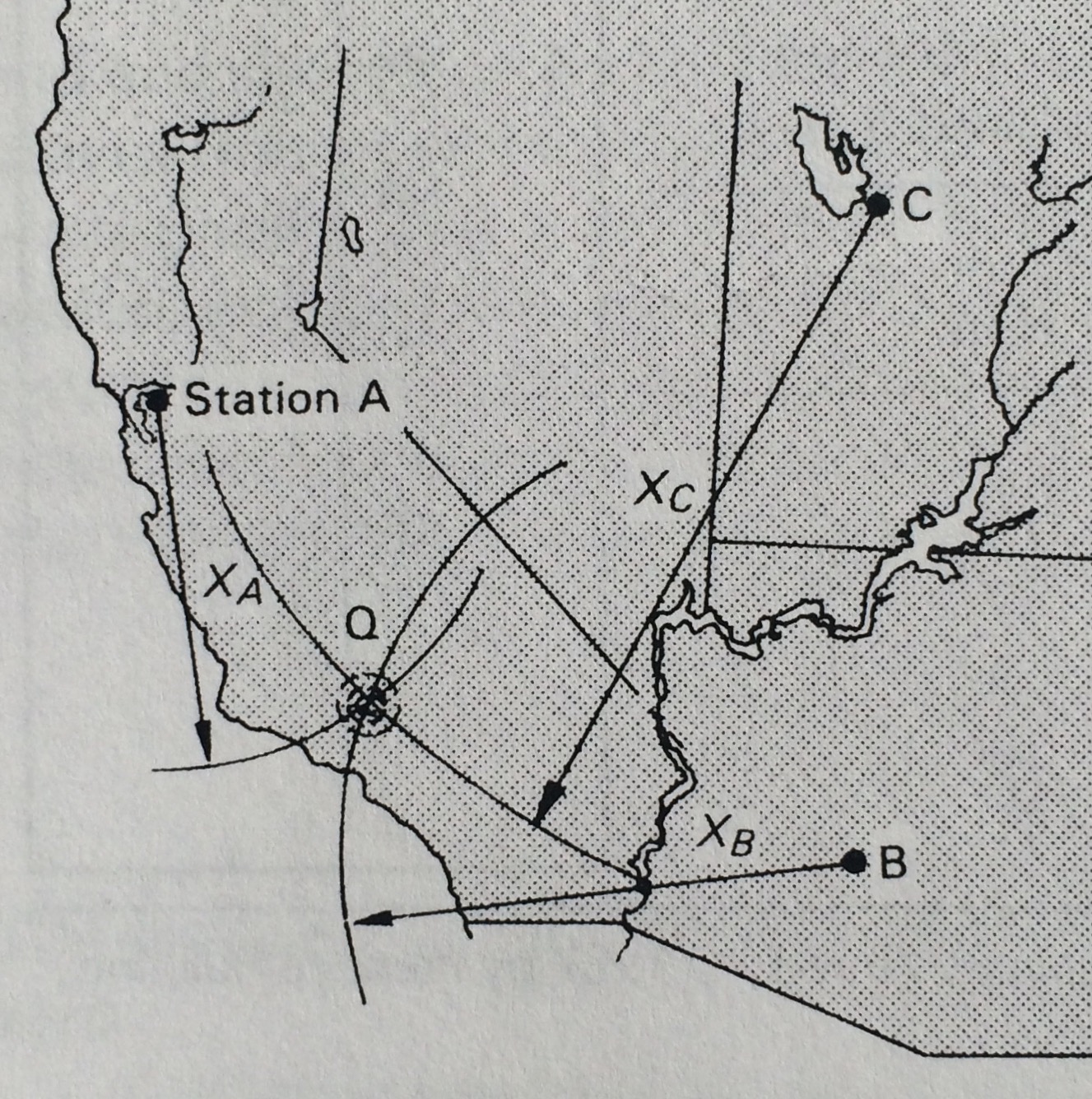
Fig 15. P and S wave time vs.
distance
Fig 16. Location of epicenter is where the 3 circles
intersect
Fig 15. and
Fig 16. Reference
Kehew, Alan E. Geology
for Engineers and Environmental Scientists. 3rd ed. Upper Saddle
River, NJ: Prentice Hall, 2006. Print.