what is the magnus effect on a ball
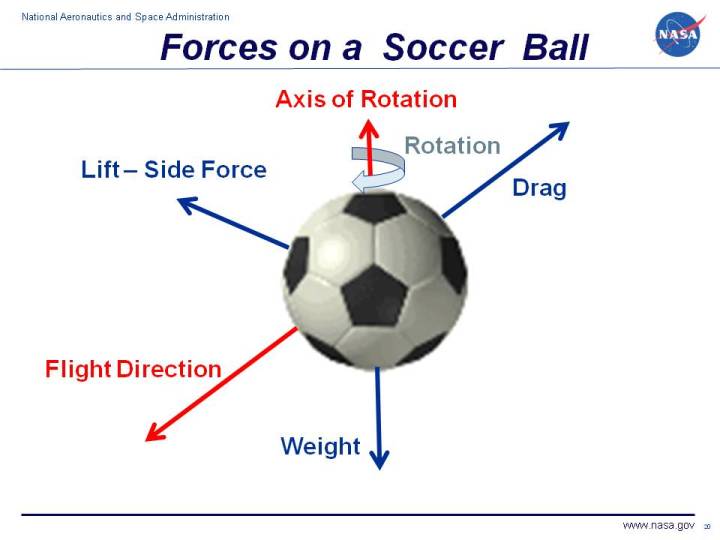
The spin of a ball comes from something known as the
Magnus effect. The Magnus effect gets it's name from a
German physicist, Heinrich Gustav Magnus, who researched and
described the effect back in 1852. However, the effect had
already been pointed out and correctly described by Isaac
Newton, long before Magnus was even alive. The ball is sent
into a spin by the player, who's foot collides in such a way
that the friction of the shoe on the ball gives it
rotational motion, as well as forward motion. The spin of
the ball deflects airflow in the direction the ball is
spinning. Because the air velocity is faster along one side
of the ball, it creates decreased pressure on that side,
something known as Bernoulli's Principle. This creates a
turbulence behind the ball, and also causes the air to exert
an unequal force on the ball (as compared with the opposite
side of the ball.) This creates an arc in the ball's
trajectory, placing a perpendicular force in the direction
to it's motion.