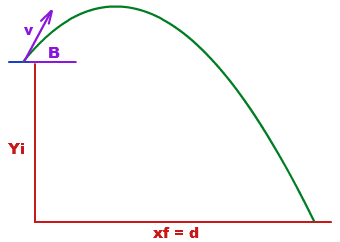
Did you know that the flight of a discus is mostly based on
2-dimensional kinematics (referring to objects in motion)? By
neglecting drag
and lift, which will be discussed in the aerodynamic section, one
can find the initial velocity of the discus, as well as the angle
of release
of the discus. These can be found by using the given height of the
discus thrower, the distance of the throw, and the flight time to
reach the
ground from release. For simplicity, we will assume the height the
discus is released is equal to the height of the thrower and air
resistance
is negligible. *This
image is not to scale. It is for display purposes.
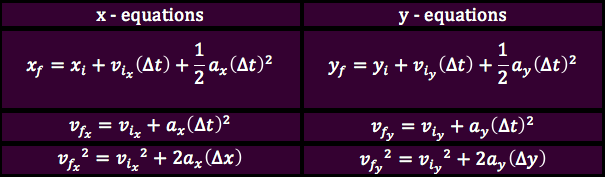
The 2-D Kinematic equations are as followed:
Using these equations, the following can be determined.
| Given: |
Knowns: |
Find: |
| · Height of the thrower = h · Final distance of throw = d · Time of flight = t |
· Acceleration
in the x-direction: a(x) = 0
m/(s^2) · Acceleration in the y-direction: a(y) = -9.81 m/(s^2) · Final velocity of the discus: v(f) = 0 m/s · Starting position of the discus: x(i) = 0 m · Final height of the throw: y(f) = 0 m |
· Initial velocity = v(i) · Angle of release of the discus = |
By manipulating the 2-D Kinematic equations,
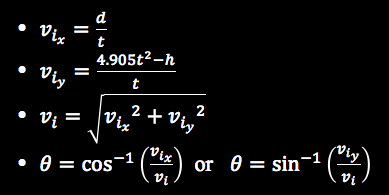
If the angle is between 35 and 44 degrees, the angle of release is optimal! Using this information, we can figure out how fast the discus rotates during the time in the air.
But this is not the only way to find the speed of the discus. We
can also use the conservation of energy to determine the initial
speed of the discus!
| Home |
Introduction |
Linear Energy |
Rotational
Kinematics and Energy |
Aerodynamics |
Bibliography |