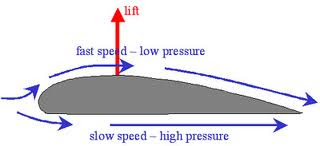
| The rotation of the
discus helps stabilize the discus flight and maintains
the launch angle. When it is properly thrown, the discus
acts like a symmetric wing. The launch angle, known as the angle of
attack, changes the flow of air around the discus. This
creates
a difference in pressure between the top and the bottom.
When the discus is released from the thrower's hand, the angle of
attack ideally creates a low pressure system above and a
high pressure system below the discus. This then creates
lift for the discus. The angle of attack that produces the best lift for
the discus is between 35° and 44°, which is equal to the
optimal angle of release,
(calculated in Linear Kinematics
page). |
Force
of Lift: 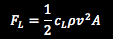 |
| c =
lifting coefficient |
v = flow
velocity |
| p =
density of fluid |
A = body
area |
| Home |
Introduction |
Linear Kinematics |
Linear Energy |
Rotational
Kinematics and Energy |
Bibliography |