
http://www.sciencebuddies.org/Files/2646/5/Phys_img190.jpg
Given
that the index of refraction would vary depending on the
amount of sugar that is put into the water, multiple tests
will have to be done at each concentration to find it's
index of refraction. On that wall, there should be a
marker of some kind, or a meter stick, so that when you
fill the prism with a fluid, you know how much the beam
got refracted:
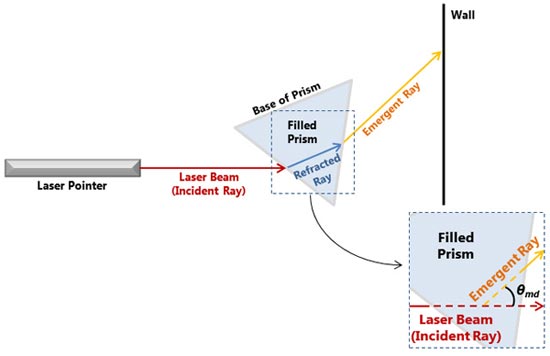
http://www.sciencebuddies.org/Files/2647/5/Phys_img191.jpg
http://www.sciencebuddies.org/Files/2647/5/Phys_img191.jpg
If you "use some
algebra [and] trigonometric identities" after applying
Snell's law twice, you get the equation to find the index
of refraction for the sugar water as:
n = Nair ×
sin[0.5(θmd + θp)] / sin(0.5θp)
Given that the
known index of air is 1.00028, θmd is the minimum
deviation, and θp is the angle of the prism, which
happens to be 60° since its an equilateral triangle, the
equation simplifies to:
n =
2.00056 × sin[0.5(θmd + 60°)]
Once you have
found the minimum angle of deviation, you can plug it
in to find the index of refraction for that specific
concentration of sugar water!