How The
HST Works
Like I said before,
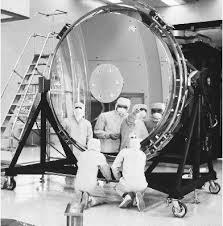
the HST is a Cassegrain reflector telescope. This means
that light enters the telescope through the opening and
bounces off the primary mirror to a secondary mirror.
The size of the telescopes mirror determines its ability
to gather light, and its ability to resolve two near
objects from one another. The way these reflecting
telescopes work is the more light it can collect and
focus into a real or virtual image, the brighter the
images. That is why the HST has a primary mirror of 7.9
feet (2.4 meters) in diameter, and a secondary mirror
of 1.0 foot (.3 meters in diameter). These mirrors
are coated with layers of aluminum measuring
three-millionths of an inch thick and magnesium fluoride
one-millionth of an inch thick. These layers make the HST
reflect visible, infrared an d ultraviolet
light.
d ultraviolet
light.
Image
courtesy of hubblesite.org
The bigger the mirror the better the quality of picture.
This is because when light passes through a narrow opening
it diffracts and spreads out. The larger the mirror
the less diffraction and spread. This is critical,
because when lights is received from two stars through
the HST you do not want these two light waves
spreading and overlapping each other. Constructing
large mirrors is extremely hard to do. The
HST mirror though is still not the largest and is
small compared to some ground based telescopes that
can be 400 inches (1000cm) and up. These large mirrors
are not the only mirrors within the telescope though.
There are many smaller, half reflective, half
transparent mirrors at the focal point that reflect
light to various instruments. Information above courtesy
of hubblesite.org, nasa.gov, and How Everything Works.
 Here
is a picture courtesy of nasa.gov
Here
is a picture courtesy of nasa.govA usually unknown
fact about the HST is that it takes pictures in black
and white, and the amazing colors seen are added from two or more black and white
exposures made through colored filters. During image
processing the colors matching the filters are added to
the picture (www.armaghplanet.com).
Power Supply and Protection
The HST’s power comes from it’s
solar panels, and uses only 2800 watts of power which is
crazy knowing that a typical kitchen kettle is rated at
2200 watts. In the hostile environment of space
Operating Hubble
The HST orbits the Earth every 97
minutes at a speed of 5 miles per second, and 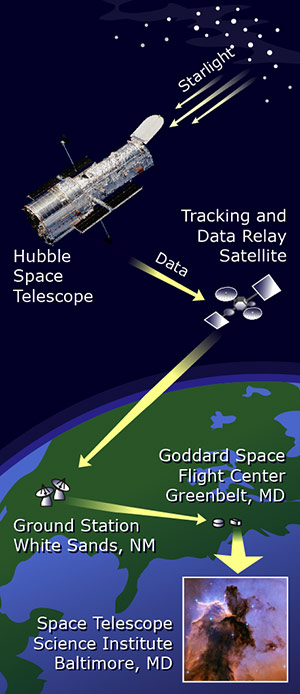 the Earth is
orbiting the Sun at 67,000 mph. This makes focusing deep
into the universe difficult when traveling at these speeds.
To stay on target the HST uses a pair of guide stars that
are located near the target. These stars are selected from a
catalog with positions and brightness’s listed. The
information given from guide stars is combined with precise
observation instructions and
the Earth is
orbiting the Sun at 67,000 mph. This makes focusing deep
into the universe difficult when traveling at these speeds.
To stay on target the HST uses a pair of guide stars that
are located near the target. These stars are selected from a
catalog with positions and brightness’s listed. The
information given from guide stars is combined with precise
observation instructions and
How To Operate The
HST
Well if you want
to operate the Hubble, you will need to become an
astrophysicist with a massive amount of research done on
what you might observe. Astronomers from around the world
fight for just minutes to use this piece of art. To get on
the schedule you must first send a proposal to the Space
Telescope Science Institute (STScI). From there a review
committee of experts go through the thousands of proposals
to only select 200 that will use the HST to its full
capabilities. Ground control though never goes off duty.
There is a 24/7 crew monitoring the HST, so it stays safe
and maintains its performance.

nasa.gov