|
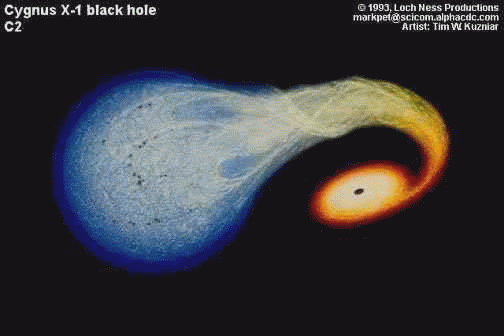
One of the more productive uses of antimatter is its use in signaling the existence of black holes. In 1974, Stephen Hawking discovered that black holes could emit a kind of radiation, by which they could be 'seen.' Around the event horizon of a black hole, the tremendous gravitational energy of the black hole can provide enough of a boost to bring a pair of particles into existence: the high temperature of material surrounding a black hole can emit high energy photons, which could interact in the gravitational field near the black hole and burst into an electron-positron pair. The event horizon would be a ring of quantum froth as particles popped in and out of existence all around the black hole, and occasionally a particle of a spontaneous particle-antiparticle pair would be sucked into the black hole. Because both energy and momentum would be conserved, the opposite particle would travel away from the black hole with as much force as the other particle is attracted. It would appear to an observer that the black hole was emitting radiation. Over time (as more and more particle-antiparticle pairs burst into being and were split apart), the black hole could actually appear to glow. It is called Hawking radiation, and is different from the x-rays emitted by accretion disks surrounding the black hole).
|