Sight

- The eye is a organ that takes
advantage of electromagnetic radiation to allow
an organism to gain information on distant
objects
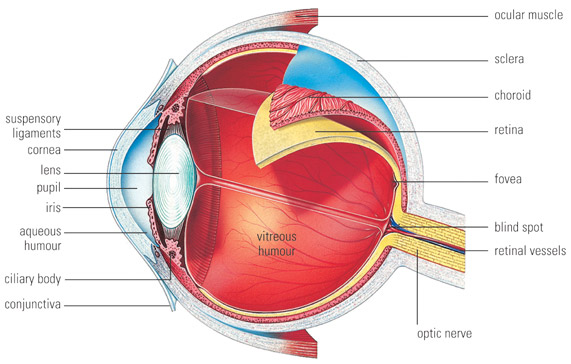
- Below is a diagram of the human
eye. Light enters through the pupal and strikes
the lens where it is diffracted and made to
focus on the retina (if the lens is in good
condition). This light then modifies the
structure of a photopigment protein which causes
a series of physiological events leading to the
brain receiving visual information via the optic
nerve. (Purves et
al., 2004)
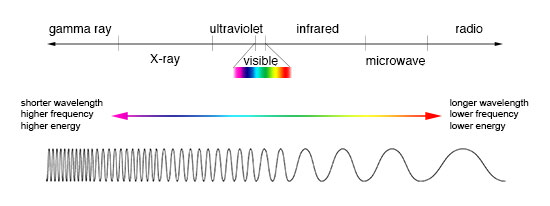
- Despite the eyes efficiency,
its still is only able to sense so much. Below
is a electromagnetic spectrum, of it only a
small fraction (the visible range) is able to
be detected by the eye.
- On the molecular level the eye
has a maximum resolution equal the amount of
photoreceptors it has, which for the average
eye is around 120 million. However, of those
120 million approximately 6 million are rods
that are sensitive to wavelength variation,
which allow for the perception of color. The
remaining 114 million cones respond to
intensity of light allowing for low light
vision. Vision is also limited by
the saturation of the photoreceptors(Quora, 2016)
Furthermore, as can be seen in the eye
diagram above, the eye also contains a blind
spot where the optic nerve meets the retina
creating a photo insensitive zone. This
blind spot is not noticed due to the brain
compensating by extrapolating information
using short term memory (Purves
et al., 2004).
|