http://hyperphysics.phy-astr.gsu.edu/hbase/thermo/carnot.html#c1
How Carnot engine works and what it is
Carnot Efficiency is theoretical
idealization of machine operating at perfect conditions.
It was theorized in 1824 by Leonard Sadi Carnot and later refined over the years.
The basic idea is that a carnot engine is essentially perfect and operates at 100% efficiency.
They works according to the following principle:
It was theorized in 1824 by Leonard Sadi Carnot and later refined over the years.
The basic idea is that a carnot engine is essentially perfect and operates at 100% efficiency.
They works according to the following principle:
http://figures.boundless.com/31197/full/figure-16-04-02.jpe
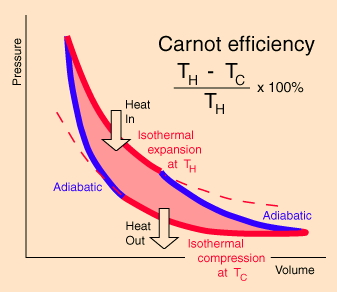
In this process the gas is isothermally
compressed from point C to D. Heat energy is removed from
the system at this point to keep the temperature constant.
The gas is then adiabatically compressed from points D to A.
It then goes through an isothermal process from points A to B where energy is added to the system via the hot reservoir.
Finally the gas expands adiabatically from B to C and returns to it's original state.
The gas is then adiabatically compressed from points D to A.
It then goes through an isothermal process from points A to B where energy is added to the system via the hot reservoir.
Finally the gas expands adiabatically from B to C and returns to it's original state.
What this means
From the above theory an equation can be
derived that is used to calculate the idea or carnot
efficiency of an engine.
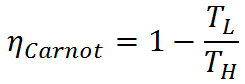
That equation is as follows bellow. Where TL is the low heat source and TH is the Hot reservoir.
That equation is as follows bellow. Where TL is the low heat source and TH is the Hot reservoir.
http://lyle.smu.edu/propulsion/Pages/Images/carnoteq.gif
This equation describes an Ideal engine
and due to the nature of entropy and enthalpy in systems
this can never be achieved as a viable engine. The point of
this is to check the theoretical value of a engine before
constructing it to see if the value is even theoretically
viable.