http://hyperphysics.phy-astr.gsu.edu/hbase/thermo/imgheat/carnot.gif
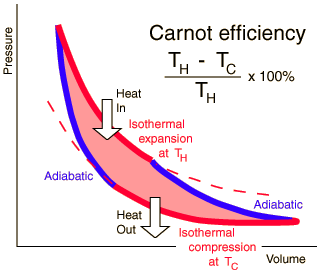
To the left is a graph of a Carnot Cycle. In terms of energy, Carnot's Cycle only takes
heat and work into account. As stated in the History section of the site, Carnot discovered
that any ideal engine has a maximum efficiency dependent on the temperature of its hot
cold reservoirs. Since the Carnot Cycle represents an ideal system, there is no friction or
other forms of irreversibility. On top of that, kinetic and potential energy are not taken
into account when observing efficiency of Carnot Cycles. Carnot Cycles consist of two
isothermal processes and two adiabatic processes. Isothermal expansions and
compressions occur at the same temperature as their respective reservoirs. Adiabatic
expansion and compression occur with no heat transfer. In the graph, work is represented
by the area between the curves. Because it is a cycle, we know that there is no change of
energy for the system. This means:
0 = Ein – Eout = ΔEsystem
Ein = Eout
It is from this idea that Carnot efficiency can be calculate. Thermal efficiency is defined
in this equation:
ηCarnot = 1 – TC/TH
Tc - Temperature of cold reservoir
Th - Temperature of hot reservoir
This is what Sadi Carnot discovered in 1824 when he researched heat engines. To this
day, no one has successfully reached a temperature of absolute zero. Because of this, we
have never had an engine with an efficiency of 100 percent. A cool site that has an
efficiency calculator for Carnot Cycles is
http://hyperphysics.phy-astr.gsu.edu/hbase/thermo/carnot.html