Particles or
Waves?

What are they?
If matter exhibits properties of
waves and particles, then which one are they?
Matter can behave as a particle or a wave, but
they can never be both of these at the same
time. Something very strange is that it changes
based on what kind of measurement technique you
are using. In the double slit experiment the
electrons produced an interference pattern when
they were fired through the barrier, but in a
modified experiment with detectors placed at the
slits in order to determine which slit the
electrons were traveling through, they began to
behave as particles. The complementary principle
says that electrons can have properties of both,
but can never coexist, and that if you "ask" the
electron a wave-type question you will receive a
wave-type answer; ask it a particle-type
question, and you will receive a particle-like
answer. Waves and particles are two sides of the
same coin. They both heavily contradict each
other, but go very well together, to the point
where you need both in order to have a full
description in physics.
DeBroglie
Waves
All
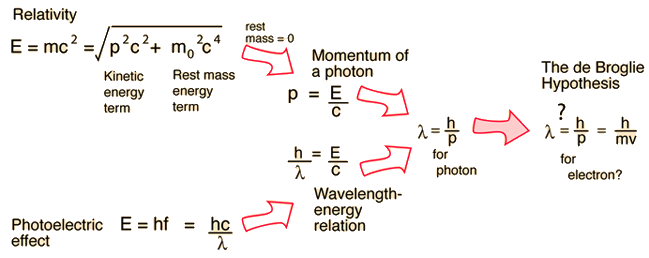
matter has a wavelength. A matter wave is called a
DeBroglie wave. The wavelength of a DeBroglie wave
is directly proportional to Planck's constant,
6.626 x 10^(-34) Js, divided by the momentum of
the object. With the objects we deal with in every
day life, we never notice anything showing
wave-type behavior, because in order to see these
behaviors the wavelength has to be comparable to
the size of the system. If you take a grain of
sand that weighs about 5 x 10^(-10) kg and have it
moving at around .5 metres per second, the
DeBroglie wavelength of the grain of sand will be
about a trillionth of the size of an atom's
nucleus. For things we deal with the DeBroglie
wavelength is too small for it to matter. When
dealing with an object like an electron, the
DeBroglie wavelength is comparable to the size of
the electron, so the wave-like behaviors become
apparent.