While playing with fluids
with straws is fun, there are more
legitimate applications... Well, some
legitimate application and some kind
of silly applications.
- Barometers and Manometers
- Finding your individual
maximum 'suckiness'
While we don't discuss it here, we
can also use basic hydraulics (p = F/A)
to determine how much force to apply on
one side of a hydraulic press to lift
extremely heavy loads with minimal
force. However, hydraulic presses are
not particularly strawlike and not
within the confines of this project.
Even if they are super cool and
effective.
Barometers
and Manometers [5][6]
One of the 'constants' we've had to
use frequently so far in our discussion
has been atmospheric pressure. But, how
can we find the atmospheric pressure in
the first place? The answer is a
Barometer.
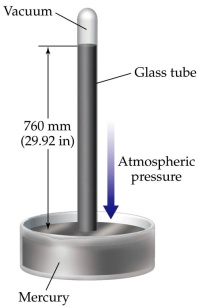
A Barometer is composed of a reservoir
that is open to the atmosphere, with an
inverted tube placed in it such that the
tube has a vaccuum (p = 0) at its top,
as shown in the figure below.
By measuring the height of the
liquid in the barometer, knowing the
gravitational acceleration, and the
density of the selected liquid, we can
accurately calculate the pressure of the
atmosphere [6].
This is important as atmospheric
pressure in not truly constant and
changes with both weather conditions and
elevation.
A manometer measures the pressure of a
gas using a very similar principle,
where the pressure of a gas in an
enclosed chamber can be found by
comparing the difference in heights
between two vertical arms of a bent
tube, as shown in the figure.
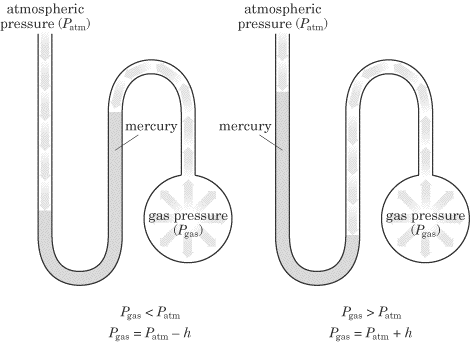
Figure From: http://slideplayer.com/slide/264590/
Finding
Out How Much You Uniquely 'Suck'
For this, you'll need a rather large
bucket, a reasonable staircase with an
open center well, and a fairly long and
flexible straw. While a single straw
(plastic tubing works well) is
preferable, you can also carefully
splice together straws into one long
straw. If you splice, be careful to get
as airtight a seal of the straw joints
as possible.
Then, the steps are simple! Place the
full bucket at the base of the stairs
and measure the height of the liquid (I
would recommend water). Then, place one
end of the straw in the bucket, start
sipping, and start climbing the stairs.
Once you reach the point where you can
no longer get liquid, take a note of
your new elevation. Note that your
elevation is not the same as the length
of the straw: we only care about
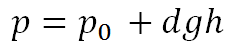
vertical distance! Then, we can use the
hydrostatic equation to find the
pressure you were able to create.
Assuming you are as
stuck on earth as the rest of us, wish
to use SI units, and are somewhere with
an elevation roughly around sea-level, p0
will be approximately 101325 Pa,
d around 1000 kg per cubic meter, and g
of 9.81 meters per second squared.
Keep in mind that your results will
likely be an under-estimate, especially
if you resorted to straw splicing, as
there will likely be some turbulent flow
and some air seepage at the straw joins.