Spacecraft Today
Let's Take the Shuttle
Special Delivery
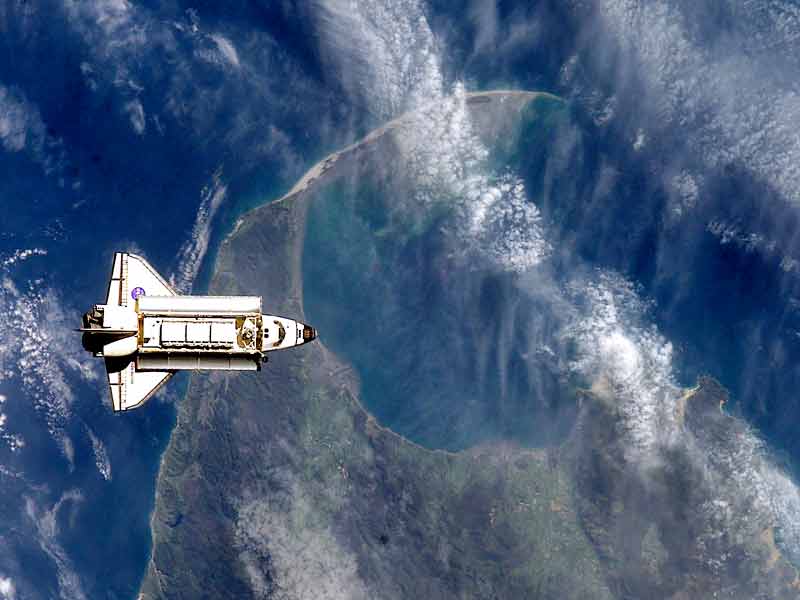
On January 5 of 1972, President Nixon approved development for the Space Shuttle. These were to be reusable orbiters with large payload capability. On April 12 of 1981, the first Space Shuttle, Columbia, would successfully launch into space with small scientific payload and a stripped-down crew of two, John Young and Robert Crippen. The objective was to test the ship’s systems. The equipment brought along for the mission was intended to measure stress on the ship and monitor such things as temperature and acceleration. After one more flight on November 12 of 1981 and two more flights in 1982, the shuttle was deemed operational by N.A.S.A. America had successfully constructed a reusable orbiter that could carry up to seven people in its upper and lower decks, and 25,000 kilograms in its payload bay. Although tragedy has struck twice amongst the shuttles, with the o-ring failure that lead to the explosion of Challenger in 1986 just 73 seconds into its flight,
and the disintegration of the shuttle Columbia during re-entry into the Earth's atmosphere in 2003, the Space Shuttles still boast a success rate of over 98%. The Space Shuttles are essentially the only truck drivers of the space industry, with their large payload capability, and have been for the last 25 years. The shuttles Endeavour, Atlantis, and Discovery remain operational, and are being modified for safety in the wake of the Columbia tragedy. They hope to resume flight sometime in mid-2005.
source: http://upload.wikimedia.org
source: http://www.virtualbay.co.nz
A shuttle over earth with its payload bay open.