Despite what you may think, holography is not just the making of ghosts. Holography is used for many things from material stress tests to instrument displays. But all of these applications follow fundamental ideas that are easiest to explain in relation to making images, holograms.
The main difference between a photograph and a hologram is the perspective. I photo only allows one perspective, that of the camera. It does not matter how you hold the photo you will never see another perspective. But a hologram allows the appearance of rotation and depth when you change your position. This is known as parallax.
One way to make a hologram is with a laser and light sensitive film. The laser is necessary because it provides a coherent light source.
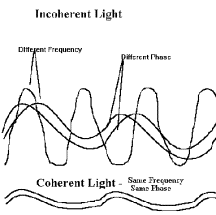
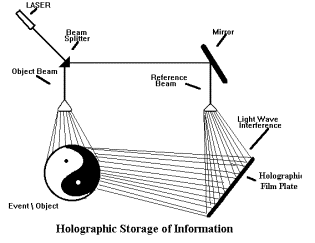
The beam is then split into a reference beam and an object beam. The object beam reflects off of the object to be recorded and the reference beam travels uninterrupted to the film. At the recording medium the two beams interact to create and interference pattern. This is why a coherent light source is necessary. Without coherence the interference pattern would be meaningless. The reason the light needs to be monochromatic is so that the all of the different wavelengths don’t wash out the interference pattern.
There are many ways to make holograms, off axis techniques, reflection, transmission, but the concept for each is similar. When the image is to be viewed the light source that illuminates it must be the same as the one that produced it. The hologram is a grating that works for the specific wavelength used to record it. If another wavelength were used it would not have the same phase relationship or interference pattern when it is reflected due to the different wavelength.