
from http://indykfi.atomki.hu/indyKFI/MT/+spark.gif
In his experiments, Hertz first employed a pair of one meter wires with a spark gap in the center connected to an induction coil. The large spheres at the ends were used to adjust the capacity of the circuit for resonance.
from http://www.sparkmuseum.com/HERTZ.HTM
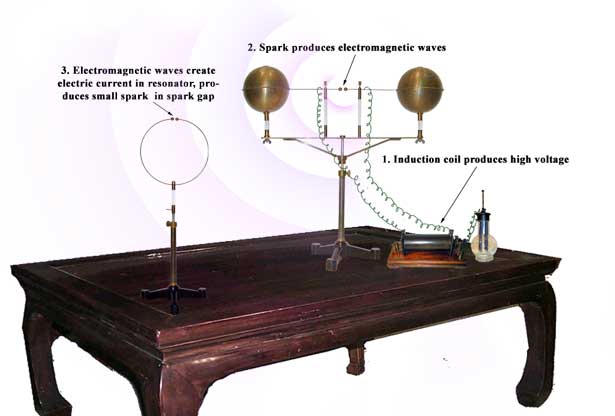
At Karlsruhe in Berlin, Hertz conducted his landmark experiments in radio transmission. After countless preliminary experiments, Hertz constructed a high-voltage transmitter circuit that included two metal spheres separated by I to 2 cm. They were positioned at the focal point of a large metal parabolic mirror. Electrical power came from o bank of wet cell batteries and an induction coil 52 cm high by 20 cm in diameter. Relay contacts provided the make-and-break cycle to generate high voltage from the coil. The rapidly oscillating ac current produced sparks that jumped the gap between the metal spheres. His receiver was a 70 cm diameter loop of wire with smaller metal spheres separated by about 3 mm at the ends. It was a forerunner of the dipole antenna. Hertz placed the receiver at different parts of a darkened room, typically 20 meters from the transmitter. High-voltage sparking at the transmitter induced weak sparks to jump the gap at the receiver. With this oscillator, Hertz solved two problems. First, he was timing Maxwell's waves;he had demonstrated, in the concrete, what Maxwell had only theorized that the velocity of radio waves was equal to the velocity of light. Second, he solved how to make the electric and magnetic fields detach themselves from wires and go free as Maxwell's waves.
In 1886, Hertz sent and received energy through space, something never done before. He conducted a series of complex experiments showing that electrical signals were energy waves, just like light. He focused the waves with different devices and calculated their lengths. He developed efficient antennas and discovered that short waves are better for information transmission than longer ones, thus establishing the foundation for modern electronic communication. His work resulted in the first long-distance radio communication with Hertzian waves, as they were called.
His name is now given to the unit of frequency - one cycle per second - (Hertz) and is abbreviated Hz. This replaced the use of cycles per second for the unit of frequency in the late 1960's.