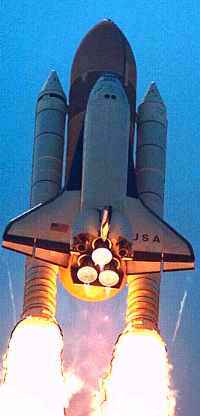
Rocket engines are different from car or jet engines in two fudamental ways.
- Unlike cars, rockets don't need to "push off" of anything to propel themselves forward.
- Rockets are self-contained. In other words they don't need oxygen from the atmosphere to provide fuel for energy.
Rockets operate using the law of conservation of linear momentum. This law states that whenever two or more particles interact, the total momentum of the system remains constant. In this case the shuttle and it's fuel can be considered seperate particles.
A rocket moves by ejecting its fuel out the nose at extremely high velocities (approx. 6000 mph). The fuel is given momentum as it is being ejected. To insure conservation of linear momentum, the shuttle must be given a compensating momentum in the opposite direction.
Rockets move exactly like Dr. Newman would if he were on a sheet of ice with 3 million pounds of baseballs throwing them at a rate of 22,000 lbs/sec. Actually Dr. Newman would move quite a bit faster, because he has MUCH less mass than the space shuttle.
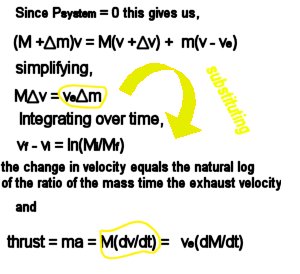

Top: Here is another good illustration of theory behind Rocket Propulsion
Left: The force exherted on the rocket by the exhaust gases (thrust) is calculated to the left using the law of conservation of linear momentum.
Symbols:
ve = velocity of exhaust relative to rocket
M = mass of rocket, m = mass of fuel ejected
i = initial, f = final
