How a Heat sink works
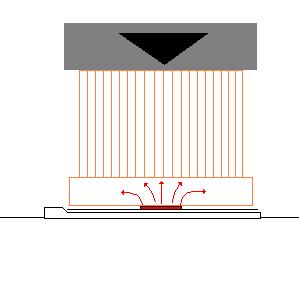
The picture shows a Fan (grey block)atop a copper heat sink in contact with a Processor (small red block)
We can express the rate at which the Heat sink transfers heat from the Processor to itself with this formula:
H = Q / Dt = - kA(DT/Dx)
H is the rate at which the heat is being transferred, equal to the amount of heat over the period of time; k is the conductivity value of the material (in this case, copper has a conductivity constant of 401, while aluminum – another popular heat sink material – has a value of only 235) A is the area of the material (in this case the surface area of all the fins and base plate), DT is the temperature difference observed between the side in contact with the processor and the fin side, and finally Dx is the thickness of the metal (which for the sake of ease, we consider the entire heat sink a cube of metal, so in practice we use the value of the thickness of the base plate of the heat sink) So we can see that a heat sink with a large Area (A) high conductivity (k), and a low thickness will conduct heat very well.
Convection