|
 |
|
|
|
|
provided by: United
States Department of Energy |
|
|
|
|
|
|
|
|
|
|
|
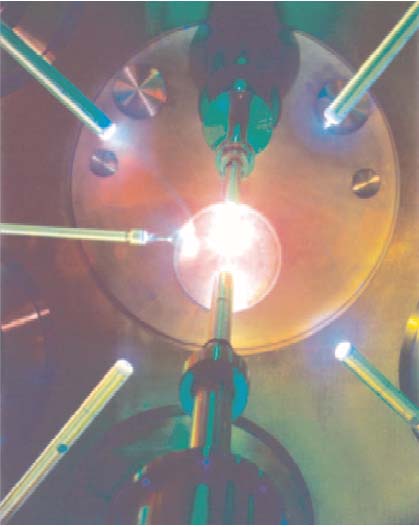
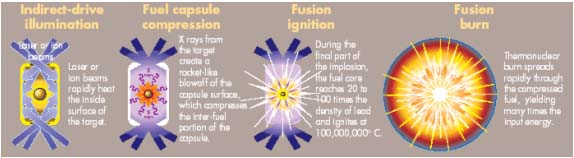
| Inertial confinement operates on the idea of
pushing two isotopes, deterium and tritium together using intense lasers,
ion beams, or X-rays. This creates a significant amount of pressure on the
atoms, compressing them to extremely high densities and temperatures, which
allows the fusion to take place in a short amount of time because of the
high density of the plasma (Fusion: Energy Source 1). In the first instances
of the reaction the outer layers of the atom are blasted away, causing the
atom's electrons to be separated from the nucleus and the atom to become
plasma. "The resulting shock waves compress the fuel [atom] into high-density
plasma. The compressed [atom] produces fusion energy until [it] disassembles,
in about a billionth of a second" (Fusion Energy Science 5).During
this process the atoms reach densities higher than |
|
|
|
|
|
|
 |
|
| Provided by: United
States Department of Energy |
|
the density at the center of the
sun, and ignite at a temperature of more that 100,000,000 degrees centigrade!
Though "inertial-confinement fusion has made impressive strides in
recent years, the technological problems of delivering huge energies symmetrically
to the target in a short time remain formidable" (Wolfson et al. 1216).
As a result of this, many physicists believe the key to creating a workable
fusion chamber on earth is through magnetic
confinement. |
|
|
|
|
|
|
|
|
|
|
|
|
|