
Kepler's First Law
Since his introduction into astronomy, Kepler had held a strong faith in the
accuracy of the theories of Copernicus. Under Copernican theory, all planets
traveled in perfectly circular orbits around the sun. However, Kepler’s
observations, especially in regards to the orbit of Mars, suggested that planets
traveled in elliptical orbits rather than circular. This was a significant finding;
one which was hard for Kepler to accept at first. However, with the advent of
calculus and Newton tackling the problem, it was proven that this was in fact
the case for all celestial bodies.
Formal Statement of Kepler’s First Law: Planets move in elliptical orbits with the sun at one focus of the ellipse.
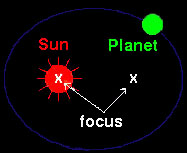
http://csep10.phys.utk.edu/astr161/lect/history/kepler.html
The above illustration exaggerates the actual orbit of a planet; an actual orbit is more circular with the two foci of the ellipse close together in the center, but explains the basic concept. With an elliptical orbit, a planet would not maintain a constant distance from a sun. It would, in fact, be closer to the sun at one point in its period than in others.