Slider.
When I deploy my chute at the terminal velocity, my speed decreases from 50 to 5 m/s.
If it opens in small dT (time delta), than force would be enough to break my neck.
F=J/dT , where F-force, J-impulse(difference in momentum) , and dT - time required for canopy to open. Let's imagine that time is dT=1/2 sec and mass = 100kg.
Impulse will be dP=mv(final)-mv(initial) = (100kg)(5m/s)-(100kg)(50m/s) = -4500 kg*m/s
Force will be F=J/dT = (-4500 kg*m/s)/(1/2s) = -9000 N
This force is big enough to kill you.
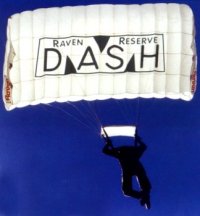
Today's canopies have a mechanism that allows them to inflate gradually and slow enough, so that the openings feel more like standing up from a chair than collision with a heavy truck moving at 60mph... It is called "slider". It is just a piece of material, that has four holes for canopie's lines. When I pack my main, I move it all the way up to the material.
In this photo you can see slider right above the jumper.
While deploing, slider is still all the way up, which does not allow the canopy to inflate all the way. It takes several seconds for slider to move down.
Usually, I have a full inflated canopy after about 9 seconds. So, the force that is acting on me is
F=J/dT = (-4500 kg*m/s)/(9sec) = -500 N. This is very much survivable :))
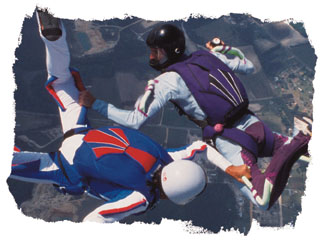
While freefalling there are two types of drag : induced and parasitic. Induced drag is the one that is created by skydiver's area. Parasitic drag is one that is created by skydiver's rough surface. The latter one prevents us from doing quick and exact motions. So, it is very helpful to reduce this drag.
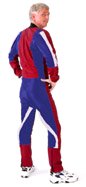
Today's equipment has excellent aerodynamics. Jumpsuits are tight and homogeneous:
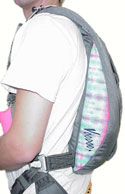
Containers are thin and small, so they do not create any editional area :