<![if
!supportEmptyParas]> <![endif]>
Bragg's Law
Contents
<![if !vml]> <![endif]>ÝÝ Introduction
<![if !vml]><![endif]>ÝÝ Hereís
How It Works
<![if !vml]><![endif]>ÝÝ Setup
for Single Crystal Bragg Diffraction
<![if !vml]><![endif]>ÝÝ Setup
for Powder Target Bragg Diffraction
<![if !vml]><![endif]>ÝÝ Experimental
Diffraction Patterns
<![if !vml]><![endif]>ÝÝ Bibliography
Introduction
Perhaps the most dramatic progress in understanding minerals
came with the discovery of X-rays. In 1912 German physicist Max von
Lane (1879-1960) demonstrated that crystals would diffract X-rays,
thus providing that minerals posses a regular and repeating internal
arrangement of atoms. By 1914, W.H. Bragg (1862-1942) and his son
W.L. Bragg (1890-1971) in Cambridge, England had used X-rays to
determine the structure of minerals. The equation they derived in
doing so has now become known as Braggís Law:
Where n is a positive integer (the index), l is the wavelength, d is the distance
between layers of atoms in the crystal, and q
is
the angle from the crystal plane (not the usual normal). The Braggs
were awarded the Nobel Prize in physics in 1915 for their work in
determining crystal structures beginning with NaCl, ZnS and diamond.
Although Bragg's law was used to explain the interference pattern of
X-rays scattered by crystals, diffraction has been developed to study
the structure of all states of matter with any beam, e.g., ions,
electrons, neutrons, and protons, with a wavelength similar to the
distance between the atomic or molecular structures of interest.
<![if
!supportEmptyParas]> <![endif]>
Hereís
How It Works
The wavelength of X-rays used in X-ray diffractometers is
around 1 or 2 Å (10-10m), which is similar to the spacing
of atoms in the structure of most minerals. The similarity in
dimensions means that the regularly spaced atoms that comprise a
crystal diffract X-rays. Based on the analysis of this diffraction in
three dimensions, it can be shown that the layers of atoms produce
diffraction maxima that effectively ìreflectî the
incident X-rays if the angle of incidence q is
appropriate.
<![if !vml]>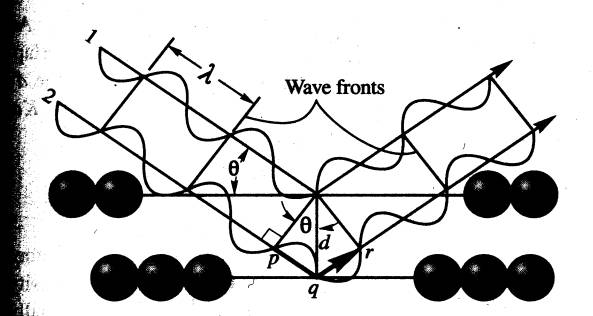 <![endif]>
Rays 1 and 2 are incident to the layers of atoms at angle q. The planes of atoms are spaced distance
d apart. Diffracted X-rays from each plane of atoms will be in phase
only if the angle q is such that the additional distance
pqr traveled by wave 2 is equal to an integer number of
wavelengths
<![if
!supportEmptyParas]> <![endif]>
Where n is an integer and l
is
the wavelength of the X-rays. The distance pqr is twice the
distance pq, which is related to the interplaner spacing d by
the equation
or
pqr = 2pq = 2d sin q ÝÝÝÝÝÝÝÝÝÝÝÝ
(Equation 3)
Combining Equations 1 and 3 yields
<![if
!supportEmptyParas]> <![endif]>
Setup for Single Crystal Bragg
Diffraction
<![if !vml]> <![endif]>
<![if !supportLineBreakNewLine]>
<![endif]>
In a
single crystal setup, an X-ray detector is mounted as shown in this
figure. A mechanical device keeps the detector oriented so that the
angle of incidence equals the angle q
of reflection for the desired
crystal plane. Peaks in the X-ray detection rate are sought as the
angle is varied. The advantage of this type of apparatus is that
diffraction peaks from only the selected crystal plane are observed.
Setup for Powder Target Bragg
Diffraction
<![if !vml]>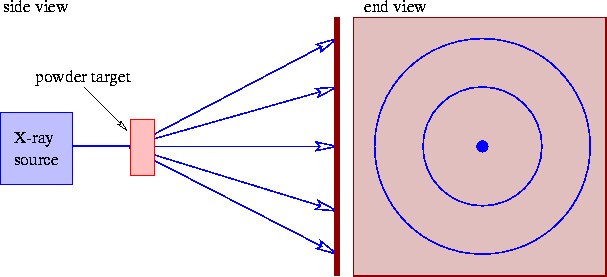 <![endif]>
<![if !supportLineBreakNewLine]>
<![endif]>
The
powder in a powder target is really a conglomeration of many tiny
crystals randomly oriented. Thus, for each possible Bragg diffraction
angle there are crystals oriented correctly for Bragg diffraction to
take place. The detector is usually a photographic plate or an
equivalent electronic device. For each Bragg diffraction angle one
sees a ring on the plate concentric with the axis of the incident
X-ray beam. The advantage of this type of system is that no a priori
knowledge is needed of the crystal plane orientations. Furthermore, a
single large crystal is not required. However, all possible Bragg
scattering angles are seen at once, which can lead to confusion in
the interpretation of the results.
<![if
!supportEmptyParas]> <![endif]>
Experimental
Diffraction Patterns
The following figures show experimental x-ray
diffraction patterns of cubic SiC using synchrotron radiation.
<![if !vml]> <![endif]>
<![if !vml]>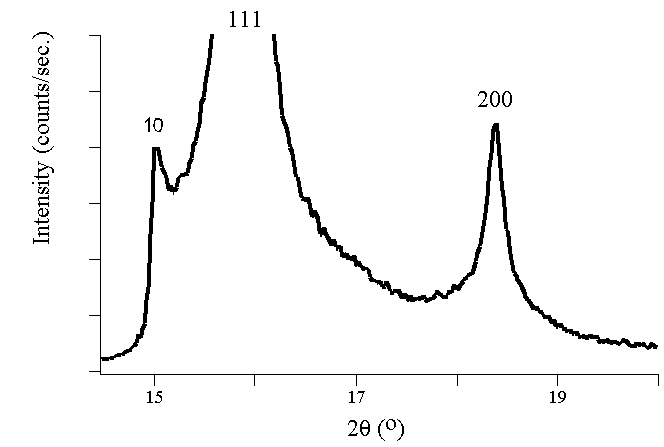 <![endif]>
ÝÝÝÝÝÝÝÝÝÝÝÝÝÝÝÝÝÝÝÝÝÝÝÝÝÝÝÝÝÝÝÝÝÝÝÝÝÝÝÝÝÝÝÝÝÝÝÝÝÝÝÝÝ
ÝÝÝÝÝÝÝÝÝÝÝÝÝÝÝÝÝÝÝÝÝÝÝÝÝ
<![if
!supportEmptyParas]> <![endif]>
Bibliography
<![if !vml]><![endif]>ÝÝÝÝ Halliday, D., Resnick, R., and Walker, J.
1997. Fundamentals of Physics Extended, 5th
edition. John Wiley & Sons, Inc., New York, p. 947-949.
ÝÝ <![if !vml]><![endif]>ÝÝÝÝ Nesse, W.D. 2000. Introduction to
Mineralogy. Oxford University Press, New York, p.162-163.
ÝÝ <![if !vml]><![endif]>ÝÝÝÝ Raymond, D.J. (1998). Powder Target.
http://www.physics.nmt.edu/blyth/phys131/book1/book1/node64.html
Ý
ÝÝ <![if !vml]><![endif]>ÝÝÝÝ Raymond,
D.J. (1998). Single Crystal. http://www.physics.nmt.edu/blyth/phys131/book1/book1/node63.html
ÝÝ <![if !vml]><![endif]>ÝÝÝÝ Schields,
P.J. (1997). What is Bragg's Law and why is it Important? http://www.journey.sunysb.edu/ProjectJava/Bragg/home.html
<![if
!supportEmptyParas]> <![endif]>
Last revised: 12/1/00