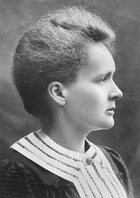
During this time, Marie received a telegram notifying her that she had been given another Nobel Prize, this time in chemistry. Although disheartened by the latest scandals surrounding her, she made it to the ceremony. She made a decided effort to include recognition for Pierre and their joint research, since she was aware of accusations that she had soiled his name.
(Photo from Nobel e-Museum website: www.nobel.se/physics)
Stress took its toll on Marie, who suffered from severe depression and acute kidney problems. She checked into a clinic under an assumed name and had a kidney operation. Feeling unworthy of her husband's name, she even forbade her daughter from addressing her letters as Madame Curie.
In late July of 1912, she sought refuge with a friend and colleague, Hertha Ayrton, who resided in England.
In December of 1912, she returned to Paris. She had been away from her lab work for nearly 14 months. Marie dedicated most of the rest of her life to the Radium Institute. Her laboratory building was finally finished in 1914.
When Germany declared war on France in September of 1914, Curie felt it her duty to help her adopted country's efforts. She was named the Director of the Red Cross Radiology Service and enlisted the help of wealthy acquaintances, auto body shops and vehicle manufacturers to do their part by donating money, time and vehicles. By October, 20 radiology vehicles were ready to be dispatched to the front lines to help field doctors locate bullets, shrapnel and broken bones.
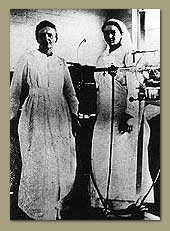
Marie and Irene with X-ray equipment at a military hospital.
Irene was awarded a military medal for her hospital work. No recognition came for Curie.
(Photo from American Institute of Physics website: www.aip.org)
To be able to drive and maintain these vehicles and effectively help wounded soldiers, Marie learned how to drive a car and gave herself cram courses in auto mechanics, anatomy and the use of X-ray equiptment.
By 1916, Marie began to train women as radiological assistants by offering courses at the Radium Institute in the necessary techniques. She needed trained personnel to help run the 20 X-ray vehicles and the 200 stationary units.
When the war ended in 1918, she spent nearly another year on war-related work. During early 1919, she offered classes in radiology to a group of American soldiers who were waiting for passage home. By fall of 1919, her laboratory at the Radium Institute was ready.